Purchase confirmed.
Your download links are on their way. Check your email now.
Your download links work for 30 days.
Procrastination, Examined
Stop Putting It Off
- PDF and ePub files
- Instant email link
- 30-day refund
- One-time payment
- Stripe checkout
- Free chapter first
- Guest checkout
What the research says about procrastination: what predicts it, what it costs students, whether treatment helps, putting off bedtime, stress and health, temptation bundling, perfectionism, and worry. Twenty-one research chapters that name each study and its size, plus a weekly routine, drills with answer keys and cards to copy.
24 chapters · 58 pages · 22 studies cited
PDF + Kindle ePub · Instant download · 30-day money-back guarantee
Buy Stop Putting It Off — $14.99Secure checkout via Stripe
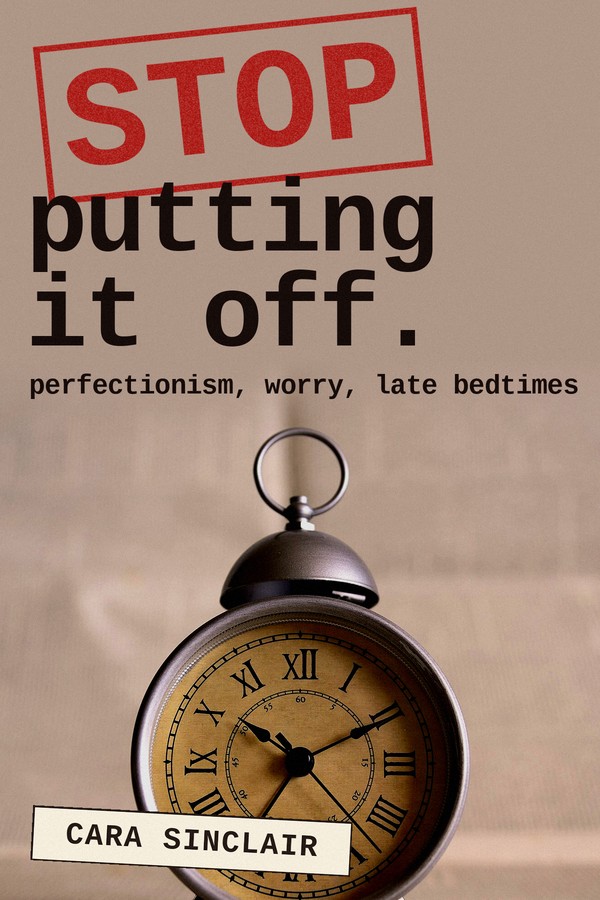
Digital download (PDF + ePub), not a printed book. The book views are illustrations. Printables and printed editions are coming soon.
What you get
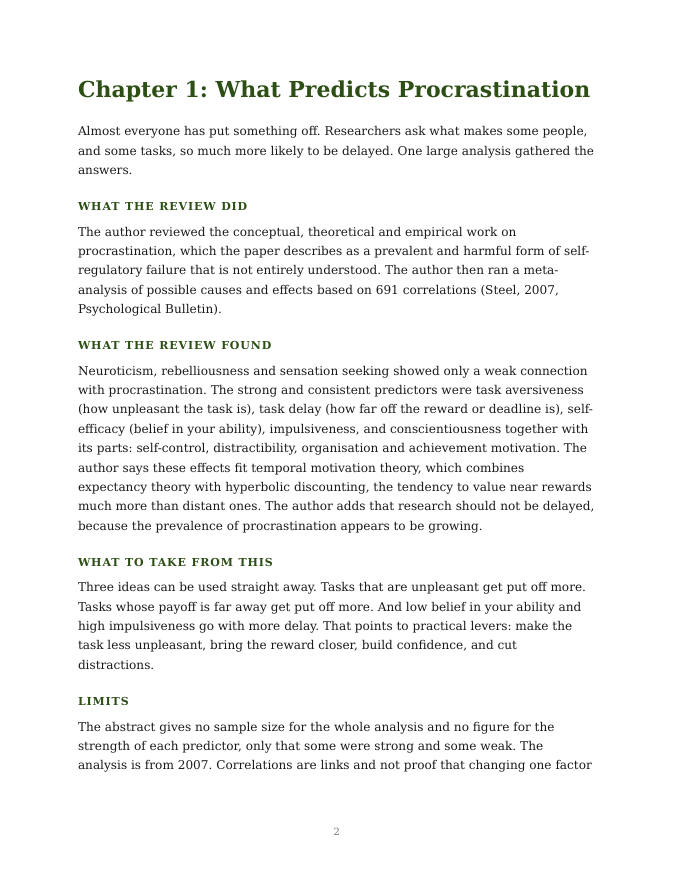
What Predicts Procrastination
A meta-analysis of 691 correlations: aversive tasks, distant rewards, low confidence and impulsiveness, and what barely mattered.
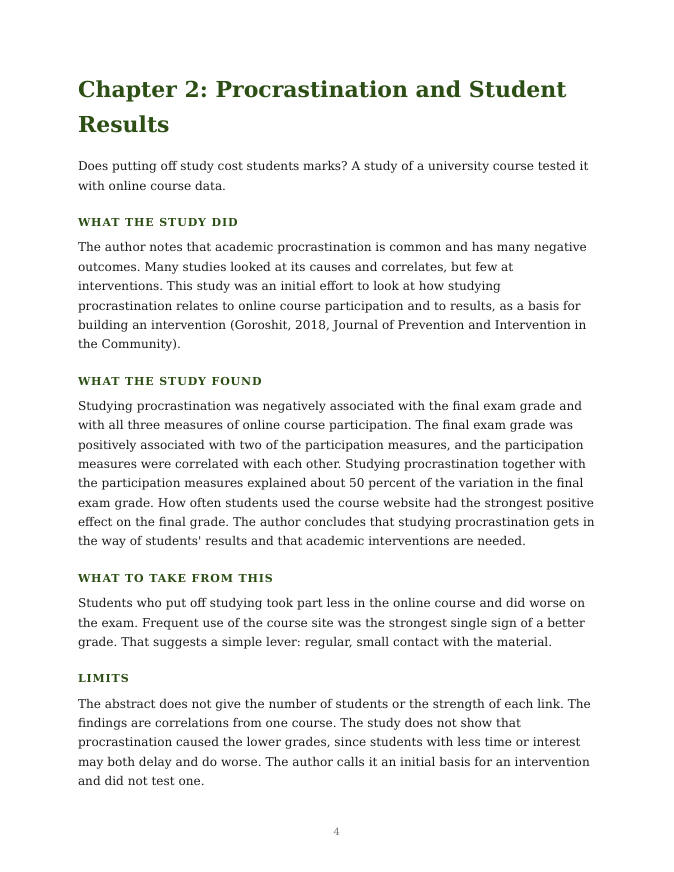
Procrastination and Student Results
Studying procrastination, online course use and final grades: together they explained about half the variation.
Does Treatment Help?
A review of 12 randomised studies (718 people): a small to moderate effect (g = 0.34), and a larger one for CBT in three studies.
Putting Off Bedtime
43 studies: bedtime procrastination went with lower self-control, evening type, shorter and poorer sleep and daytime tiredness.
Being Kind to Yourself at Bedtime
Two surveys (241 and 546 people): self-compassion went with less bedtime delay, partly through fewer bad feelings.
Procrastination, Stress and Health
36 samples and 8,603 people: chronic procrastination went with poorer self-rated health (r = .21), partly through stress.
Bundle the Treat With the Task
A field experiment: gym-only audiobooks raised visits by 51 percent at first, then the effect faded.
When High Standards Hold You Back
A review of eight studies on reducing perfectionism in clinical groups: large drops on most measures.
Worry and Rumination That Keep You Stuck
A review of 19 studies: mindfulness-based and cognitive treatments may reduce both.
Fresh Starts
Five experiments: emphasising a date that marks a new beginning raised intentions to start, partly by leaving the past imperfect self behind.
Deadlines You Set Yourself
Experiments on precommitment: people set costly deadlines and they help, but outside deadlines worked better.
Value, Impulse and Mood
Over 600 people: not seeing the value, wanting rewards now and lack of stamina explained most of procrastination, and delay can be a mood strategy.
A Smartphone App for Putting Things Off
A pilot of 31 people: two brief sessions plus 14 days of app training cut procrastination more than a waitlist.
Two Weeks Online, With or Without Texts
161 students: the online course reduced procrastination significantly only when daily texts were added.
A Behavioural Plan for Going to Bed on Time
60 young adults: bedtime delay fell by 35.56 percent, about 46 minutes, and sleep efficiency rose.
Does Delay Lead to Worse Health Later?
3,525 Swedish students: more procrastination went with more depression, anxiety, stress and pain nine months later.
Delay and Negative Feelings: 88 Studies
63,323 people in 17 countries: a moderate link (r 0.342) between procrastination and negative emotions.
Night Owls and Self-Control
308 college students: an evening preference went with lower self-control and more procrastination.
Planning, Organising and Starting: Executive Skills
212 college students: weak starting, planning and tracking skills predicted more academic delay.
Looking Ahead, Self-Control and Screens
377 Korean students: a present focus went with weaker self-control, more delay and more heavy internet use.
When Making a Plan Backfires
Two studies: if-then plans backfired for people high in socially prescribed perfectionism.
A Practice Routine
Five if-then plans and a light weekly routine that turn the book into habit.
Drills: Spot the Lever, Start, Check
Name the lever behind a delay, shrink a task, design a bundle, read the numbers, claim checks and kind rewrites, with checked answers. Practice material, not research.
Tools and Glossary
A start card, delay log, good-enough card, worry card, one-page checklist and a glossary of 23 terms. Practice material, not research.
What makes this different
Every research claim names its study
Each research claim names the study and its size where the abstract gave it. A Sources section lists all 22.
Evidence kept apart from advice
Suggestions and invented examples are labelled as practice material, and the book says where a link is not a cause.
Cards and drills you can use today
A start card, a delay log, drills with answer keys, labelled as practice material, not research.
Read the first 3 chapters free
Download chapters 1 to 3 before you decide. No email required.
Download free chapters (PDF)Look inside
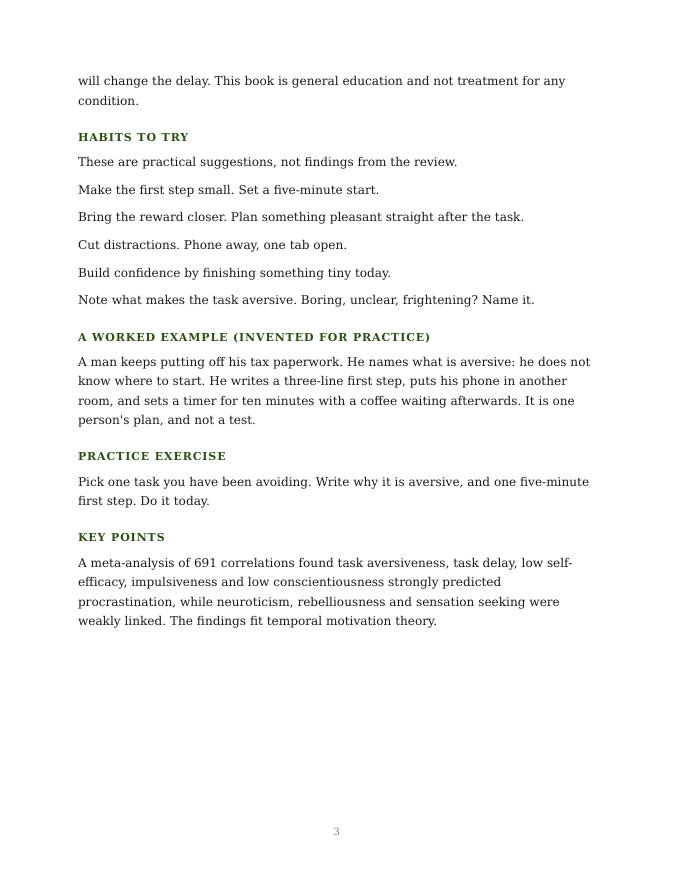
Real pages from Stop Putting It Off
These pages come straight from the free chapter. The full workbook is written the same way.
Questions before you buy
What do I get?
The full book as a PDF and as an ePub for Kindle and Apple Books. One purchase, one flat price, no subscription.
How do I receive it?
You pay on a secure Stripe checkout page. The download link is sent to your email right after purchase.
What if it is not right for me?
You get a full refund within 30 days of purchase, no questions asked. Email the address in your confirmation message.
Can I read a sample first?
Yes. Get Chapter 1 free by email and read it before you decide.
Get Stop Putting It Off
PDF + ePub. Instant download. 30-day guarantee.
$14.99Buy Stop Putting It Off — $14.99Secure checkout via Stripe. 30-day money-back guarantee.