Purchase confirmed.
Your download links are on their way. Check your email now.
Your download links work for 30 days.
Money and Wellbeing, Examined
Spend Well
- PDF and ePub files
- Instant email link
- 30-day refund
- One-time payment
- Stripe checkout
- Free chapter first
- Guest checkout
What the research says about money and how you feel: two kinds of well-being, income and the famous 75,000 dollars claim and its correction, spending on others, buying time, experiences or things, money worries and thinking, debt, and years of hardship. Twenty-four research chapters that name each study and its size, plus a weekly routine, drills with answer keys and cards to copy. Not financial advice.
27 chapters · 66 pages · 26 studies cited
PDF + Kindle ePub · Instant download · 30-day money-back guarantee
Buy Spend Well — $14.99Secure checkout via Stripe
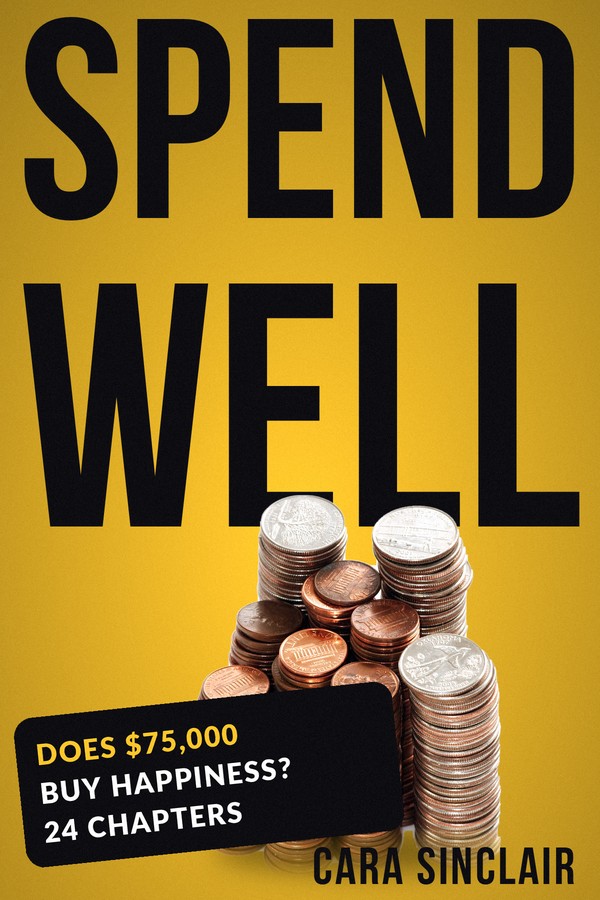
Digital download (PDF + ePub), not a printed book. The book views are illustrations. Printables and printed editions are coming soon.
What you get
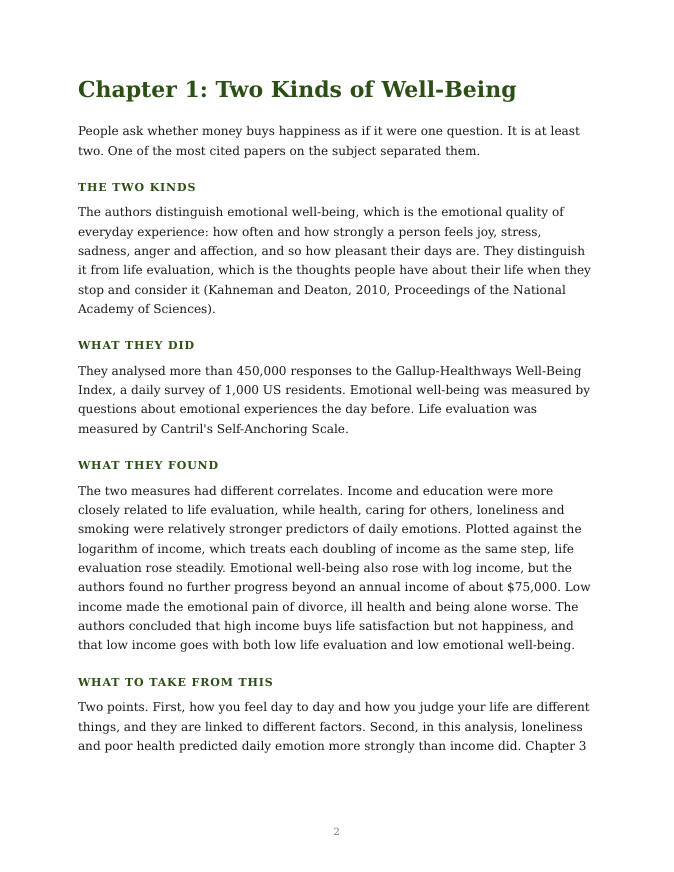
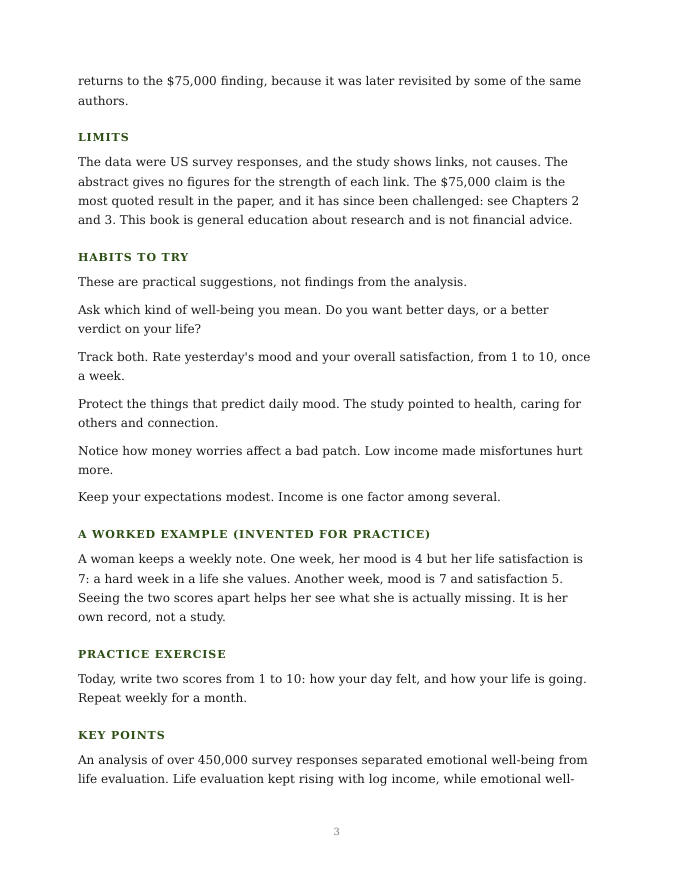
Two Kinds of Well-Being
More than 450,000 survey responses: how days feel and how you judge your life have different predictors.
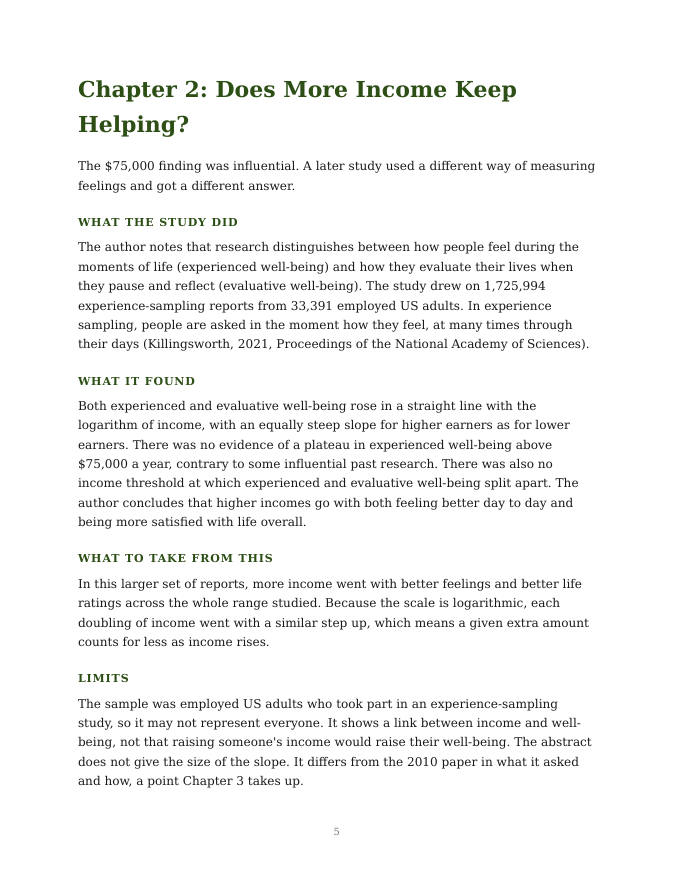
Does More Income Keep Helping?
1,725,994 reports from 33,391 employed US adults: well-being rose with log income with no plateau above 75,000 dollars.
The Conflict Resolved
An adversarial collaboration: flattening only among the least happy, and why the first measure had a ceiling.
Spending on Others
A survey, a windfall field study and a randomised test: spending on others made people happier.
Giving Around the World
136 countries and experiments in four: the link held in poor and rich countries alike.
Buying Time
6,271 people in four countries and a field experiment: paying for time-saving services and life satisfaction.
Experiences or Things?
Studies of social class: experiences suited higher-class buyers, while lower-class buyers were as happy or happier with things.
When Money Worries Crowd Out Thinking
A study of poverty and thinking, with farmers measured before and after harvest, and a published comment that disputed the lab part.
Debt and How You Feel
Reviews of 52 and 39 studies: debt, financial strain, anxiety and depression.
Years of Hardship
1,167 adults aged 65 and over: how long hardship lasted mattered most for late-life health.
When Money Is Given Directly
A meta-analysis of 45 studies and 116,999 people: cash transfers had small positive effects, larger when the transfer was larger.
Wealth as a Buffer
A long-running study of people nearing retirement: above-median wealth went with a much smaller fall in well-being after a disability.
When Money Becomes the Main Goal
753 effect sizes from 259 samples: materialism went with lower well-being, most strongly for risky behaviours and self-appraisal.
Does Spending on Others Really Make You Happier? A Replication
Registered replications with 712, 1,950 and 5,199 people: greater happiness in two experiments, small differences.
When Money Is the Main Goal: An Early Study
Three studies linking money as a central goal with lower well-being and adjustment.
Why More Money Does Not Always Mean More Happiness: Relative Income
A review of how comparing income with others and with your past can explain a puzzle.
Does Inequality Make a Country Less Happy?
39 studies, 24 in the meta-analysis: a pooled link of about zero, varying by country development.
The Pain of Paying
How paying can hurt, why cards hide it, and why people like flat rates.
Paying Not to Go to the Gym
7,752 members: 4.3 visits a month and about 600 dollars given up on average.
Why We Spend Today What We Planned to Save: A Theory
A theory paper on present bias and hard-to-sell assets.
What Happens to Spending When the Check Runs Out
Bank records: spending fell sharply when unemployment benefits ended.
Debt and Mental Health in Asia
Nine papers linking debt with depression, anxiety, stress or suicide ideation.
Can Money Lessons Change Money Habits?
A review of financial education; what it covers and the questions to ask.
What the New Studies Add
A summary of Chapters 14 to 23 and what they add to the earlier advice.
A Practice Routine
Five if-then plans and a light weekly routine that turn the book into habit.
Drills: Check the Claim, Check the Purchase
Two kinds of well-being, experience or thing, reading the numbers, claim checks, a gift plan and a time-buy plan, with checked answers. Practice material, not research or advice.
Tools and Glossary
A weekly score card, giving log, time-buy list, purchase check, worry card, checklist and a glossary of 21 terms. Practice material, not research.
What makes this different
Every research claim names its study
Each research claim names the study and its size where the abstract gave it. A Sources section lists all 26.
Corrections and disputes included
The famous income claim, its correction by its own authors, and a published comment on the poverty study are all reported, so you can see the evidence move.
Cards and drills you can use today
A weekly score card, drills with answer keys and a log, labelled as practice material. Not financial advice.
Read the first 3 chapters free
Download chapters 1 to 3 before you decide. No email required.
Download free chapters (PDF)Look inside
Real pages from Spend Well
These pages come straight from the free chapter. The full workbook is written the same way.
Questions before you buy
What do I get?
The full book as a PDF and as an ePub for Kindle and Apple Books. One purchase, one flat price, no subscription.
How do I receive it?
You pay on a secure Stripe checkout page. The download link is sent to your email right after purchase.
What if it is not right for me?
You get a full refund within 30 days of purchase, no questions asked. Email the address in your confirmation message.
Can I read a sample first?
Yes. Get Chapter 1 free by email and read it before you decide.
Get Spend Well
PDF + ePub. Instant download. 30-day guarantee.
$14.99Buy Spend Well — $14.99Secure checkout via Stripe. 30-day money-back guarantee.