Purchase confirmed.
Your download links are on their way. Check your email now.
Your download links work for 30 days.
Creative Thinking, Examined
Make Room for Ideas
- PDF and ePub files
- Instant email link
- 30-day refund
- One-time payment
- Stripe checkout
- Free chapter first
- Guest checkout
What the research says about creative thinking and ten small habits: setting a problem aside, letting the mind wander, walking, mood, sleep, meditation, working in groups, time in nature, napping and creative confidence. Twenty-one research chapters that name each study and its size, plus a weekly routine, drills with answer keys and a toolkit with a glossary.
24 chapters · 59 pages · 22 studies cited
PDF + Kindle ePub · Instant download · 30-day money-back guarantee
Buy Make Room for Ideas — $14.99Secure checkout via Stripe
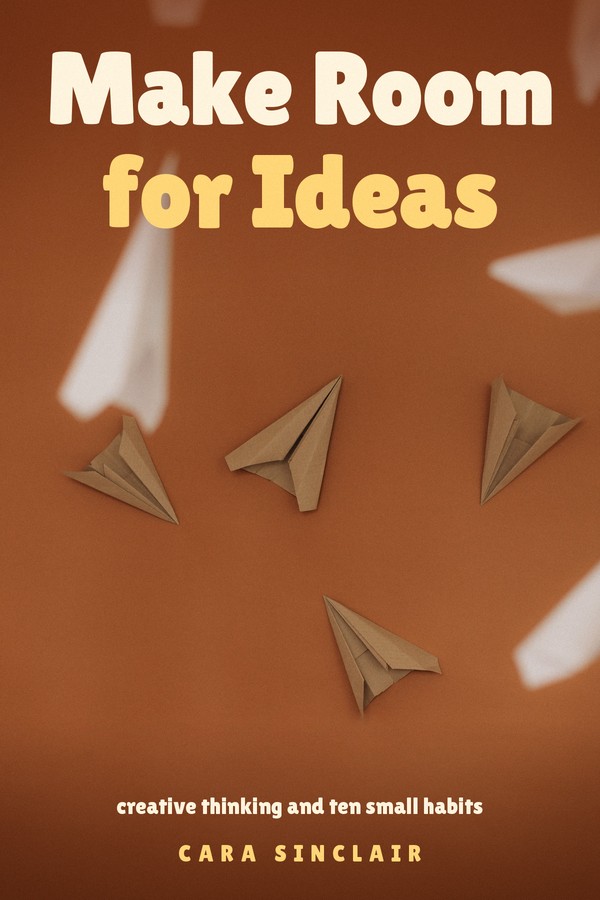
Digital download (PDF + ePub), not a printed book. The book views are illustrations. Printables and printed editions are coming soon.
What you get
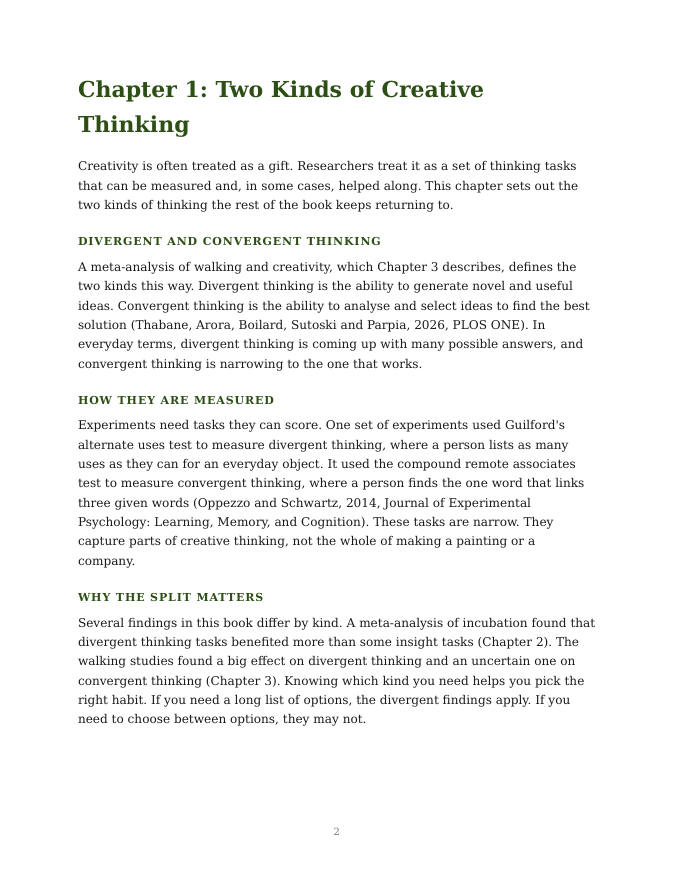
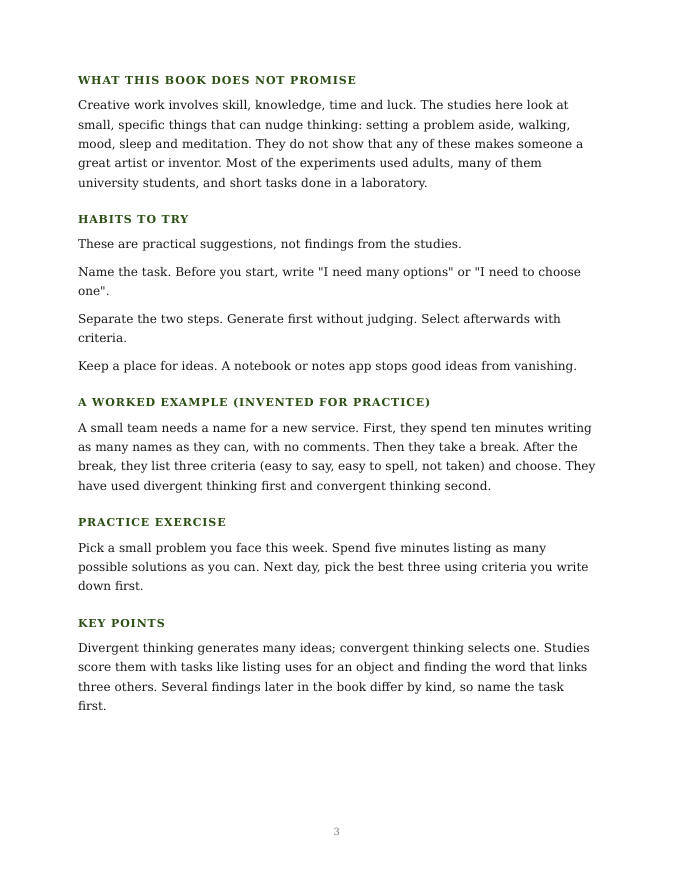
Two Kinds of Creative Thinking
Divergent and convergent thinking, how researchers measure them, and why the split decides which habit to use.
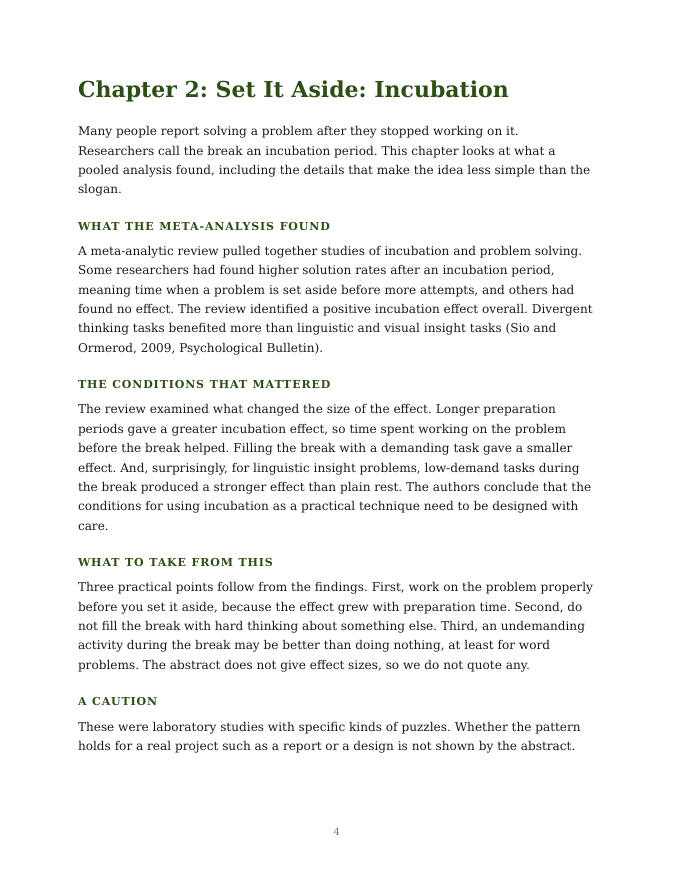
Set It Aside: Incubation
What a pooled analysis found about taking a break, and the conditions that made the effect bigger or smaller.
Walk It Out
Four experiments and a pooled analysis of 23 studies with 1,036 participants on walking and idea generation.
Mood and Ideas
What 102 effect sizes showed about happy, calm, sad and anxious moods and creativity.
Sleep On It
A study in Nature where more than twice as many people found a hidden rule after sleep.
Meditation and the Style of Thinking
Open-monitoring and focused-attention meditation and the kinds of thinking each went with.
Let the Mind Wander
A study where an undemanding break task beat a demanding task, rest and no break, and what mind wandering had to do with it.
Ideas in Groups
A brain-imaging study of groups of four: flexibility versus copying, and what predicted group creativity.
Time in Nature
Hikers after about four days in nature without screens scored 50 percent higher on a creative task, and why the cause is unclear.
Napping and the REM Effect
A nap study: REM sleep, more than quiet rest or non-REM sleep, helped link unassociated ideas.
Believing You Can: Creative Confidence at Work
A six-month study of employees: role identity and expectations raised creative confidence, while demands lowered it.
Does Focus Help Creativity? A Null Result
Three studies: working memory capacity and in-the-moment mind wandering did not predict idea generation.
The Cost and the Benefit of Wandering
Three experiments: wandering slowed reaction times and went with better creative problem solving afterwards.
What Happens in the Brain When Ideas Come
A pooled analysis of brain-imaging studies: idea generation draws on a network of regions, not one spot.
Practising Divergent Thinking
30 people: two weeks of idea exercises was followed by greater frontal alpha synchronisation.
Large Groups: Side by Side or in a Chain?
A field study in two organisations: parallel groups gave more unique ideas, serial groups more elaboration.
Who Is in the Brainstorm?
2,261 business students in random groups: all-women groups beat groups with a single woman among men.
Looking at Examples: Pictures or Real Objects?
Design novices: no difference in copying or originality, but real objects gave more complete designs.
Respect, Trust and Self-Belief at Work
267 employees over eight months: more trust and respect went with more creative self-belief and more idea action.
A Supportive Place to Learn and to Innovate
499 valid replies from nursing students: a positive practice environment went with more innovative behaviour.
Practice, Persistence and Challenge
823 students aged 13 to 17: deliberate practice had a positive effect on creative performance (beta 0.309).
A Practice Routine
Seven if-then plans and a light weekly routine that turn the book into habit.
Drills You Can Do Today
Alternate uses, remote associates with checked answers, quantity, selection, constraint, mind-wander and group drills. Practice material, not research.
Tools and Glossary
A toolkit, a one-page checklist and a glossary of 24 terms. Practice material, not research.
What makes this different
Every research claim names its study
Each research claim names the study and its size where the abstract gave it. A Sources section lists all 22.
Habits kept apart from evidence
Suggestions and invented examples are labelled as practice material, so you can tell what was tested from what was not.
Drills with answer keys
Alternate-uses and remote-associates drills, a log and a checklist so you can test the habits on yourself.
Read the first 3 chapters free
Download chapters 1 to 3 before you decide. No email required.
Download free chapters (PDF)Look inside
Real pages from Make Room for Ideas
These pages come straight from the free chapter. The full workbook is written the same way.
Questions before you buy
What do I get?
The full book as a PDF and as an ePub for Kindle and Apple Books. One purchase, one flat price, no subscription.
How do I receive it?
You pay on a secure Stripe checkout page. The download link is sent to your email right after purchase.
What if it is not right for me?
You get a full refund within 30 days of purchase, no questions asked. Email the address in your confirmation message.
Can I read a sample first?
Yes. Get Chapter 1 free by email and read it before you decide.
Get Make Room for Ideas
PDF + ePub. Instant download. 30-day guarantee.
$14.99Buy Make Room for Ideas — $14.99Secure checkout via Stripe. 30-day money-back guarantee.